Save this exact graph
Keep the pinned video_minimax_h3_t2v.json copy so its node graph remains tied to the revision measured here.
Official template · text-only input · measured here
This is the local text-to-video template in ComfyUI's official template browser. It loads FL2VA, starts without a source image, and generated a 1344×768 clip with native audio in the measured run below.
Prompt-only behavior
This guide is for ComfyUI users who want the exact prompt-only graph, its required files and a measured baseline before they commit to a full local T2V run.
The pinned graph leaves both first_frame and last_frame disconnected. Your prompt supplies the shots, motion and sound direction; the H3 node produces a video stream and a native audio track, which the SaveVideo node writes together.
That makes this the clean starting point when there is no source image whose composition must survive. If one image should anchor the first frame, use the I2V template. If reference media should guide identity, style or motion, use the R2V template.
MiniMax H3 Community License Agreement (2026-08-02) authorises use, reproduction, modification, distribution and display of the weights and their Outputs only in the Applicable Territories — the world excluding the EU, the UK, the Republic of Korea and the United States. Running the weights locally on your own machine is one of those enumerated acts, so the territory clause applies to a local install too, and §V.4 reaches Outputs as well as the weights themselves. This site quotes and links the license rather than advising on it — read the file-to-license map and the original agreement for your own situation.
Frozen Comfy-Org graph
video_minimax_h3_t2v@7837633a.json42,197 bytes · SHA-256 31ab33fdb053a7834cc866bd7aa08b887518fc656e4a796c89779c6b5e1786e6
Frozen from Comfy-Org/workflow_templates@7837633a… on 2026-08-21. The template is MIT-licensed; the required copyright and permission notice is in LICENSE.txt. The model weights follow their own licenses.
Why freeze it? The upstream file can change under the same name. Pinning the revision makes the graph you download the same graph whose loaders, defaults and SHA-256 this page describes.
Source-bound visuals
These are evidence plates, not decorative mockups. The first maps the three live links in the committed JSON; the second copies the two retained run records and their shared output hash from the public ledger. Neither image contains MiniMax-generated output.
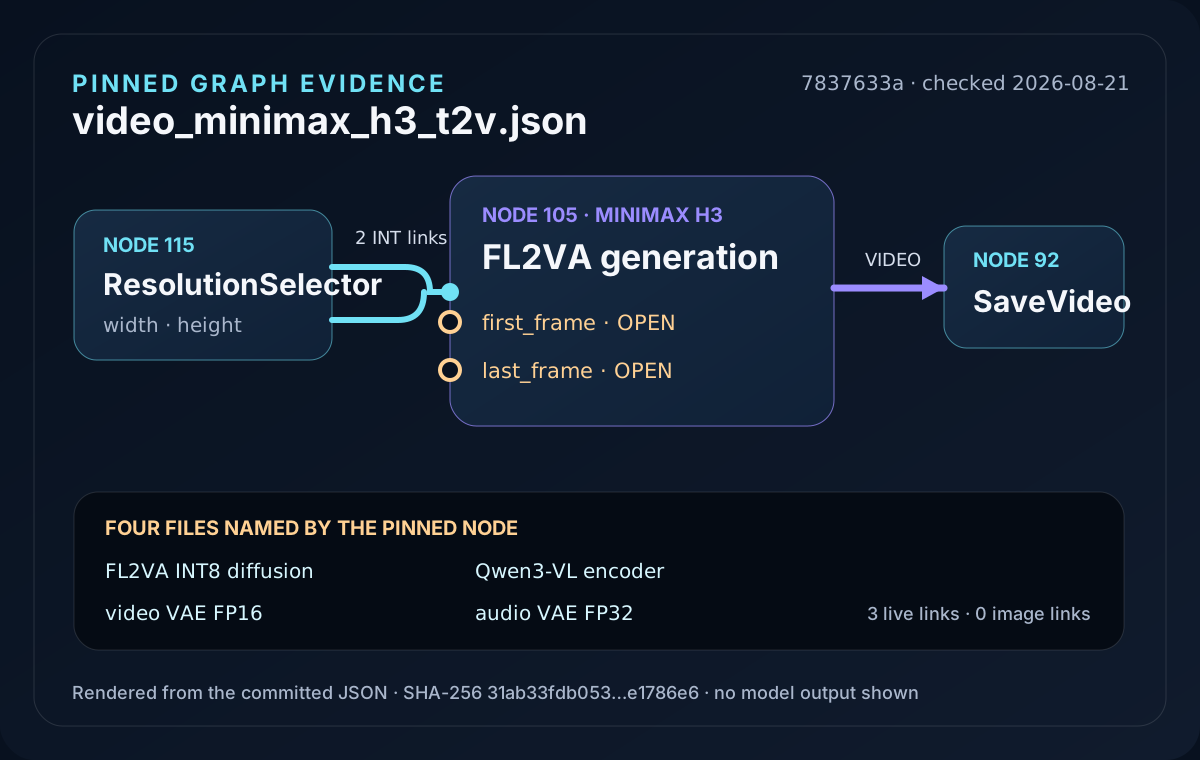
video_minimax_h3_t2v@7837633a.json, checked . Open it full-size to inspect the port states.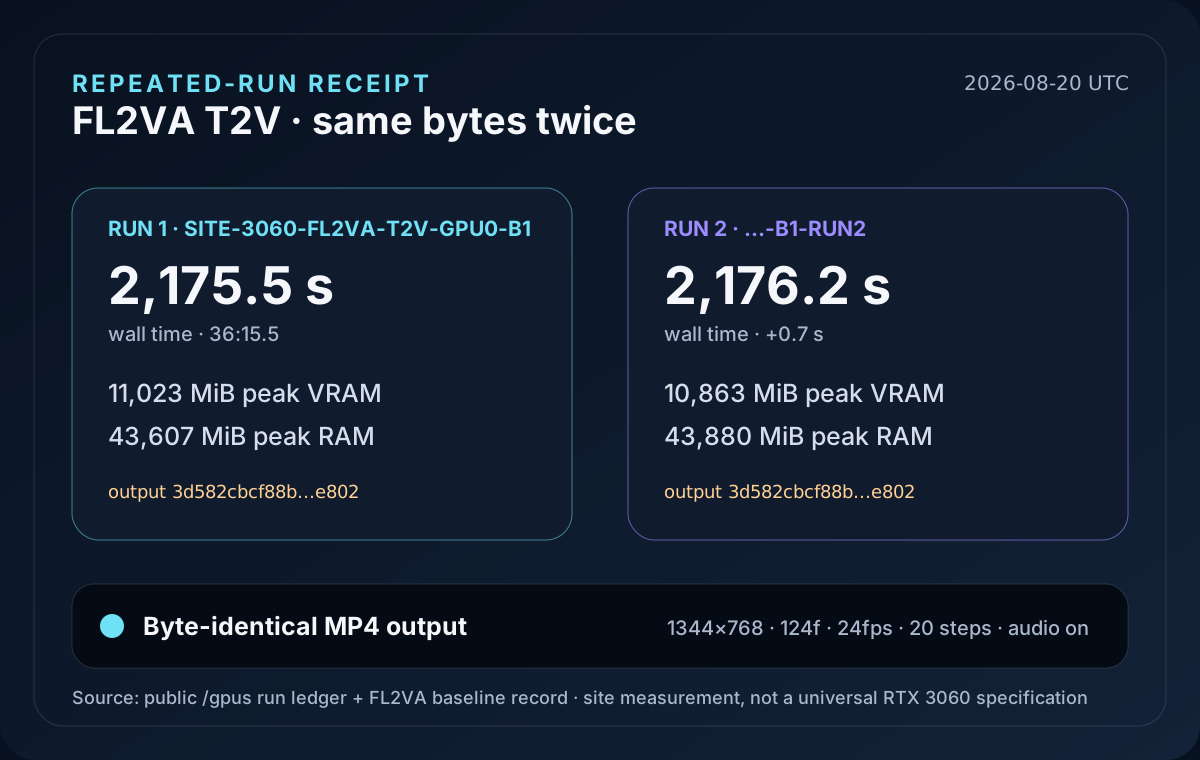
Evidence sources: the committed UI graph, public run ledger and the complete FL2VA baseline record.
Model identity
The local T2V and I2V templates both load minimax_h3_fl2va_pruned_int8_convrot.safetensors. The R2V template does not: it loads a separate Ref2VA file. If you already installed I2V, T2V adds no second diffusion-model download.
Two naming families look almost identical. Base diffusion checkpoints use fl2va and ref2va, with the final a. Distilled LoRA file names use fl2v and ref2v. Do not rename one family to resemble the other; the loader must point at the file that actually exists.
The full six-template map and the two-step disk plan live on the workflows hub. This page stays with the one graph it measured.
Four loaders
ComfyUI/
└── models/
    ├── diffusion_models/
    │   └── minimax_h3_fl2va_pruned_int8_convrot.safetensors
    ├── text_encoders/
    │   └── qwen3vl_32b_minimax_h3_nvfp4_awq.safetensors
    └── vae/
        ├── minimax_h3_video_vae_fp16.safetensors
        └── minimax_h3_audio_vae_fp32.safetensors
The pinned template names all four files directly. Before the benchmark, the same file names were checked against the test machine's model manifest; no Turbo LoRA, cache node, SageAttention package or custom node was present.
The Qwen3-VL encoder's upstream project is Apache 2.0 — read the upstream Qwen3-VL license — while the Comfy-Org repackage is delivered through a repository marked with the MiniMax H3 community-license metadata. Download entrance matters; the file-to-license map keeps those tracks separate.
Template and loader source: the pinned Comfy-Org JSON, checked 2026-08-21. Folder placement and loader troubleshooting are covered once in the ComfyUI setup guide.
From download to first run
Keep the pinned video_minimax_h3_t2v.json copy so its node graph remains tied to the revision measured here.
Place FL2VA in diffusion_models, Qwen3-VL in text_encoders, and the video and audio VAE files in vae.
Open the JSON in an updated ComfyUI and confirm that every loader resolves before queuing a job.
Choose an aspect ratio and megapixel preset in ResolutionSelector; its width and height links override the numbers displayed inside the H3 node.
Prove the prompt, video, audio and save path on a small canvas before committing to a full 1344×768 run.
Site test card
SITE-3060-FL2VA-T2V-GPU0-B1SITE-3060-FL2VA-T2V-GPU0-B1-RUN2res_multistep · simple · denoise 13d582cbcf88b3aa8d60e93cea4c65bba445ab475c8c3243591107c7dab4ee802bf4c9a08….video_minimax_h3_t2v.json@7837633a…; API workflow SHA-256 1b083dfa1a4540b3805b998a66f5585f4337d5fbe14b441ca7ac0a2e1bf545a2.c628dfa…dc4; seed 20260820; no first or last frame.contaminated=false; ComfyUI process restarted before each run; host page cache uncontrolled.Full record: download the complete FL2VA T2V/I2V baseline report, including asset fingerprints, workflow hashes, smoke runs, both formal runs and retained evidence locations.
These are two observations from one fixed machine, not a specification for every RTX 3060. Both original timings remain visible; neither is replaced by a single summary value.
Workload lever
With no source image to resize, the test held the prompt, seed, model, sampler and audio path fixed and changed the output workload. The smoke test used 512×288 and 22 frames; the formal pair used 1344×768 and 124 frames.
| Run | Pixel-frames | Wall time | Peak VRAM | Peak RAM |
|---|---|---|---|---|
| Smoke | 512×288 × 22 | 51.8 s | 11,625 MiB | 42,511 MiB |
| Formal Run 1 | 1344×768 × 124 | 2,175.5 s | 11,023 MiB | 43,607 MiB |
| Formal Run 2 | 1344×768 × 124 | 2,176.2 s | 10,863 MiB | 43,880 MiB |
The formal workload contains about 39.5× as many pixel-frames as the smoke test and took about 42.0× as long. Peak VRAM did not move in the same direction: all three readings stayed between 10,863 and 11,625 MiB. On this workload, reducing the canvas bought time, not proportional graphics-memory headroom.
Duration is the second workload control, but it does not translate into an arbitrary frame count. The pinned graph converts seconds to H3's valid 17k+5 frame grid at 24 fps; a five-second entry becomes 124 frames. Shortening the value therefore moves between valid blocks rather than subtracting frames one by one.
The file also exposes one positive prompt and no negative-prompt socket. For a clean first diagnosis, leave that prompt and the seed fixed while changing only ResolutionSelector or duration. A source image cannot be the hidden variable on this graph, because neither frame input is connected.
The selector bundled with the pinned JSON starts at 16:9, 0.4 megapixels and a multiple of 32; its own reference table maps that preset to 864×480. The 1344×768 figures above came from a separately frozen benchmark setting and must not be read as the template default. For the memory mechanism, see the VRAM guide; for the 43GB-class host-memory peak, see the system RAM guide.
Default-setting source: the pinned Comfy-Org template and its bundled size table, checked 2026-08-21. The smoke and formal values are site measurements recorded under separate test_id values in the run ledger.
Keep the baseline clean
This T2V pair is the unaccelerated denominator for the site's same-machine Turbo LoRA test. The dedicated /loras/turbo guide will own the LoRA file names, step counts, shift settings and A/B conclusion; until that page ships, they are deliberately not duplicated here.
The underlying Turbo records already live in the benchmark ledger. Keeping the interpretation off this filename page prevents a baseline download guide from turning into a second accelerator guide.
Failure routing
Match the exact file name and folder shown above. A file in checkpoints will not satisfy a loader looking in diffusion_models.
Update ComfyUI, restart it and verify the MiniMax loader chain. The setup guide shows the hidden subgraph and first smoke test.
Do not assume VRAM is the only limit. The formal T2V runs peaked above 43,600 MiB of system RAM; check host-memory headroom.
Start from the exact error or behavior in the symptom-led troubleshooting guide instead of changing several settings at once.
Decision
Bottom line: choose this file when no source image needs to survive into the clip. Install the shared four-file FL2VA stack, import the pinned JSON, keep both frame ports open and prove the path with a small smoke test before increasing the workload.
The measured 36-minute pair is a planning reference for this one RTX 3060 setup, not a promise for another card or host. If a first image must anchor composition, stop here and switch to the I2V graph; if reference media should guide identity or style, use R2V.
Your next action is concrete: download the pinned T2V JSON, verify its SHA-256 and run the small test before changing prompt, duration or canvas.
FAQ
Our 1344x768, 124-frame runs took 2,175.5 seconds and 2,176.2 seconds. Both used the same fixed workflow and seed, and both complete MP4 files had the same SHA-256.
No. The pinned video_minimax_h3_t2v.json graph leaves both image inputs disconnected. It starts from the prompt and produces video with a native audio track.
It loads minimax_h3_fl2va_pruned_int8_convrot.safetensors. T2V and I2V share that FL2VA file; R2V uses a separate Ref2VA diffusion model.
That is not what our two workload sizes showed. The small smoke test finished far sooner, but peak VRAM stayed in the same roughly 11GB band, so a smaller canvas is not proportional VRAM relief.
Next checks