Third-party distillation · three files · measured here
MiniMax H3 Turbo LoRA: 3 Files, Fixed Steps, Measured on a 3060
Turbo is not a MiniMax accelerator — it is a third-party distilled LoRA. The official Comfy-Org packaging loads exactly three Turbo files, and each file's step count and shift pair are bound to it rather than tuned freely. Everything measured below comes from one RTX 3060 12GB.
2,175.5 sTurbo off · wall timeRun 2: 2,176.2 s · 20 steps
526.7 sTurbo on · wall timeRuns 526.7–528.9 s · median 528.6 s · 4 steps
4.132×Paired A/B rangePaired 4.113×–4.132× · both raw times in the A/B below
No reliable dropPeak VRAM findingPeaks 10,479–11,185 MiB; all three Turbo peaks above 8,192 MiB
Measured 2026-08-19 to 2026-08-20 UTC · Same prompt, seed and card on both sides · Independent guide, not affiliated with MiniMax or Comfy-Org Updated:
The page's main promise
The three files you can actually load in ComfyUI
These are the only three Turbo LoRA files repackaged for ComfyUI in the Comfy-Org repository as of 2026-08-17. Each row is one file with the task it serves, the step count its upstream specification fixes, and the two shift schedules that travel with it. Third-party conversion repositories distribute other Turbo files under different names — where those download links actually point is the troubleshooting finding below.
Checked against the Comfy-Org repackage at pinned revision dc559027… and the ModelTC parameter README at commit a7e148b8… on 2026-08-18, re-checked 2026-08-20.
The step count belongs to the selected LoRA's upstream specification, not a free dial. The circulating "6–8 steps" advice is off-specification for this series.
Video and audio shift are two independent schedules. Set both, not just the video one.
File name, steps and shift are used as a set. A partial combination is an invalid configuration, not a variation.
LoRA file names use fl2v / ref2v with no trailing a. Diffusion weights use fl2va / ref2va. The two spellings are not interchangeable.
The Turbo download that points at the wrong repository
Hard-coded by third-party template hubs such as RunComfy
minimax_h3_turbo_4step_pruned_comfyui.safetensors
The download link those templates ship points at the wrong repository. RunComfy's actual anchor targets Comfy-Org/MiniMax-H3/resolve/main/H3/minimax_h3_turbo_4step_pruned_comfyui.safetensors, and that exact URL returns 404. Separately, the official loras/ tree carries only the three _comfyui_bf16 files in the table above and has no same-named file. If the download fails, the problem is the template's link, not your network or your ComfyUI install.
The same-named file does exist somewhere else: the third-party conversion repository drbaph/MiniMax-H3-Turbo-Lora-ComfyUI at revision 4728c77e… has served it since 2026-08-06 (introducing commit b6ac1b80…), and the pinned copy measures 620,285,648 bytes. That repository is a derivative-conversion distribution, not a third training series: its README describes this file as a pruned/curve-form compatibility conversion of Larryvrh's Turbo LoRA, and the file's own metadata is a partial conversion (partial_conversion=true, target MiniMax-H3-pruned-curve) carrying a verbatim warning: "All AdaLN LoRA adapters were removed because the source targets input dimension 2688 while the pruned model targets dimension 8. Four-step distillation behaviour may be degraded or broken." It is not an official equivalent of anything in the table above.
How it was checked (2026-08-27): the RunComfy public workflow page and workflow JSON were read directly; the page's download anchor targets the exact Comfy-Org/H3/ resolve URL, which returns 404, while the JSON cites the same file name; the official loras/ tree was checked separately; the drbaph pinned file page resolves at 620,285,648 bytes; and the conversion metadata above was read from the file's own header.
Practical routing: use one of the three official files with its bound parameters, and only reach for the drbaph conversion if you specifically run the pruned-curve model variant it targets — its parameters follow the Larryvrh series rules, and its own warning applies. The symptom-led guide covers the loader errors a missing or misplaced file produces.
Do not mix parameters
Two independent Turbo series
Two unrelated project families publish MiniMax H3 Turbo LoRAs. Their parameters are not compatible across series, and this page's A/B used only the first one.
minimax_h3_turbo_v4_step600_ema.safetensors, ≈780 MB; its README suggests 4–8 steps, strength 1 and shift 12/3 for its own files only
The Larryvrh README values — 4–8 steps, strength 1, shift 12/3 — apply to Larryvrh files only. Carrying them over to any LightX2V file is an invalid configuration, and this page does not do it anywhere.
Juxtaposition, never a verdict
Claimed versus measured
The claimed column records what this site could verify about each circulating claim — not the claim restated as given. The measured column carries this site's own raw values. Nothing is computed between the two columns.
Claimed (circulating)
What the source check found
Measured here
"up to 5×"
The pinned ModelTC README at commit a7e148b8… does not contain it. The closest sourced wording is the Larryvrh README at revision 43a74557…, checked 2026-08-19: "as few as 4 sampling steps instead of the usual ~20 — a ~5× sampling speedup" — a step-count ratio with no hardware, wall time or test date. No source states the number with a hardware environment and test date, so it stays unpublished as a claim (re-checked 2026-08-27).
Same-machine paired wall-time range 4.113×–4.132× — Turbo off 2,175.5 s / 2,176.2 s at 20 steps against Turbo on 526.7 s / 528.9 s / 528.6 s at 4 steps (full A/B).
"runs better on 8G cards"
Recorded the same way: no source, environment or date on file, so it is not published as a verified claim.
This run did not establish a reliable peak-VRAM reduction. All three Turbo peaks were above 8,192 MiB; this was not an 8GB-card test.
Why the two columns move differently: fewer steps shrink the sampling segment only. VAE decode, text encoding and model loading do not scale with the step count, so wall time fell here while peak VRAM stayed in the same band. The cache-node family measured the same direction for a different lever — the cache-node page owns that evidence, and this page does not restate its tables.
One machine, one matched intervention
The A/B, in full
Both sides ran the same prompt, seed 20260820, 1344×768 canvas, 124 frames at 24 fps, the same res_multistep sampler, simple scheduler, BasicGuider, audio path and the same four base weights, on the same physical GPU 0 and software build. Steps and shift differ because they are part of what was tested: each side runs its own file's bound values, and both are printed.
the base template has no shift node — not explicitly set
6 / 3, two independent schedules
LoRA strength
not applicable
1.0 — this site's value; the upstream project publishes no recommendation, and none is invented here
Why only this file gives a clean comparison at 1344×768: the 4-step v1.0 768p LoRA was trained at exactly 1344×768. The only Ref2V Turbo file is the 4-step v0.1 trained on 544p mixes, so running it at 768p would be a training/inference mismatch rather than an equivalent A/B.
Measurement
A · Turbo off
B · Turbo on
ComfyUI wall time
2,175.5 s / 2,176.2 s
526.7 s / 528.9 s / 528.6 s — median 528.6 s, range 526.7–528.9 s, no mean taken
Peak VRAM (GPU 0)
11,023 / 10,863 MiB
11,185 / 10,479 / 10,895 MiB
Output repeats
both complete MP4s byte-identical
all three complete MP4s byte-identical
On this same RTX 3060 workload, the paired wall-time range was 4.113×–4.132×. That ratio is arithmetic between this site's own measurements on one machine: A-side 2,175.5 s / 2,176.2 s against B-side 526.7 s / 528.9 s / 528.6 s, at 20 versus 4 steps. It is published as a pairing and never averaged into a single number, and it is never compared against the unverified "up to 5×" text.
Same physical GPU 0, NVIDIA GeForce RTX 3060 12GB; same host; GPU 1 stayed 113→113 MiB on all three runs, contaminated=false.
Software
Identical build to the A side: Ubuntu 24.04.4, driver 580.173.02, CUDA 13.0, PyTorch 2.13.0+cu130, ComfyUI bf4c9a08…; ComfyUI process restarted before each run.
Workflow / revision
B-side API workflow SHA-256 735972cab03bca6fb010da173b2b51e42b3cadd3e107188e51005e157b14d10a, byte-identical across all three runs; derived from the A-side file by adding the LoRA loader, the shift node and the step change.
Prompt / seed
Same prompt bytes, SHA-256 c628dfa…dc4; same seed 20260820; same canvas, frames and fps.
LoRA
minimax_h3_fl2v_turbo_4step_v1.0_768p_comfyui_bf16.safetensors — 1,956,192,992 bytes, SHA-256 c396a9a06f58399e9df9754b18299818d84a2ddd371724ba48fe4a41221437dc, from the Comfy-Org repackage at pinned revision dc559027….
Steps / shift / strength
4 steps; shift video 6 / audio 3 as two independent schedules; strength 1.0 — this site's value, the upstream project gives no recommendation.
Output
Three complete MP4s of 2,650,811 bytes, all SHA-256 e3f19c0d8c4ea937cf9ffaca66739bb73b3ca1ef2875dfae7aa6a1c72f260bc2 — byte-identical repeats.
Full record: every retained run, including the smoke run and the retained orchestration failure, lives in the run ledger. This is a site_benchmark pair, not a reproduction of any community claim.
Presented, not scored
Same seed, side by side
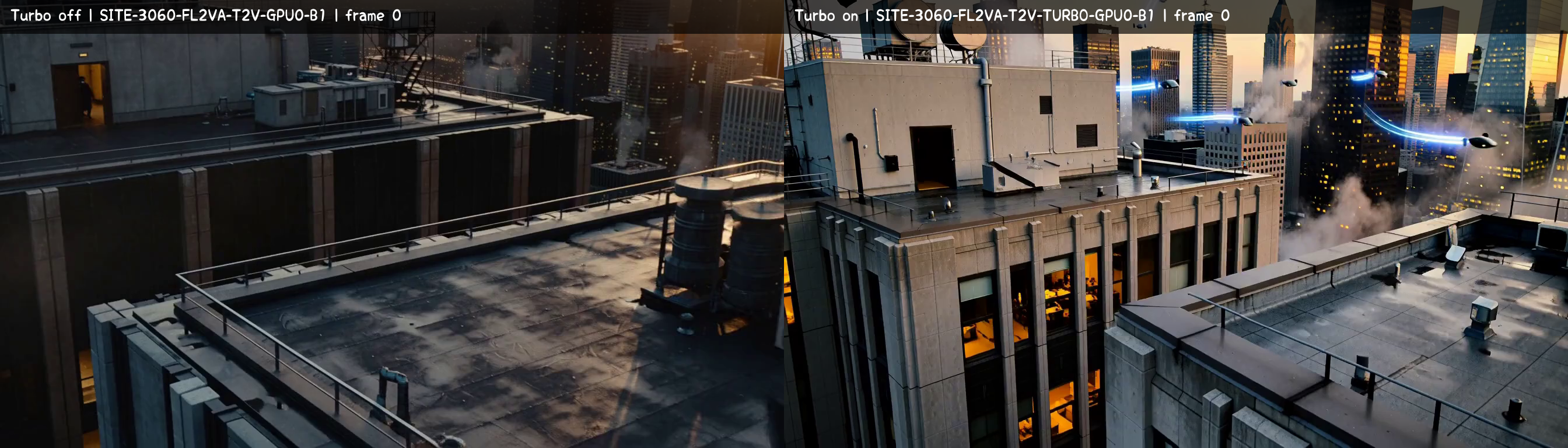
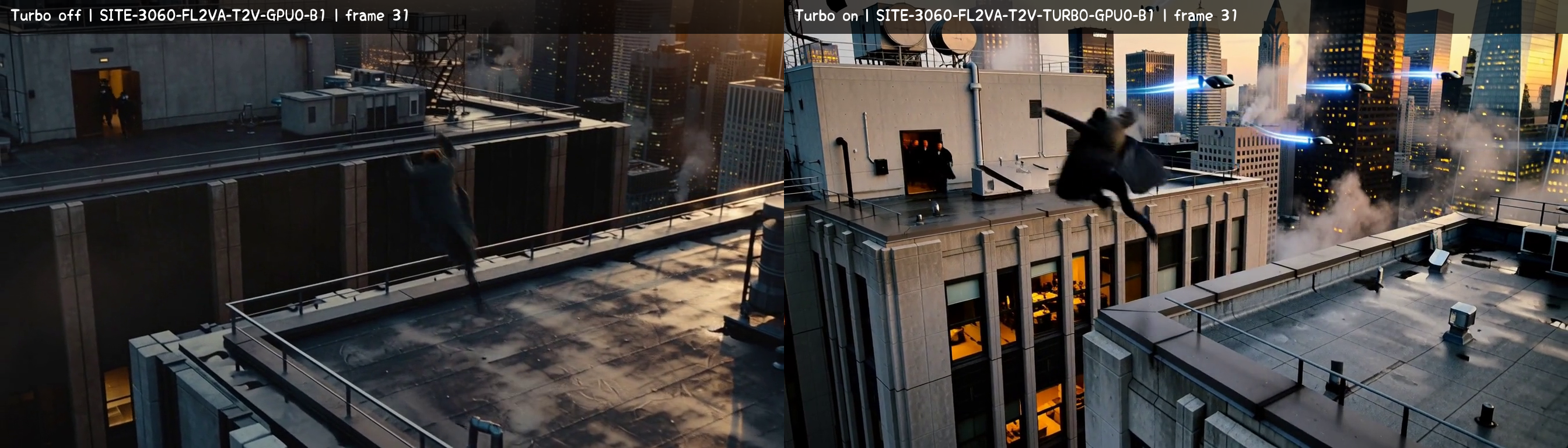
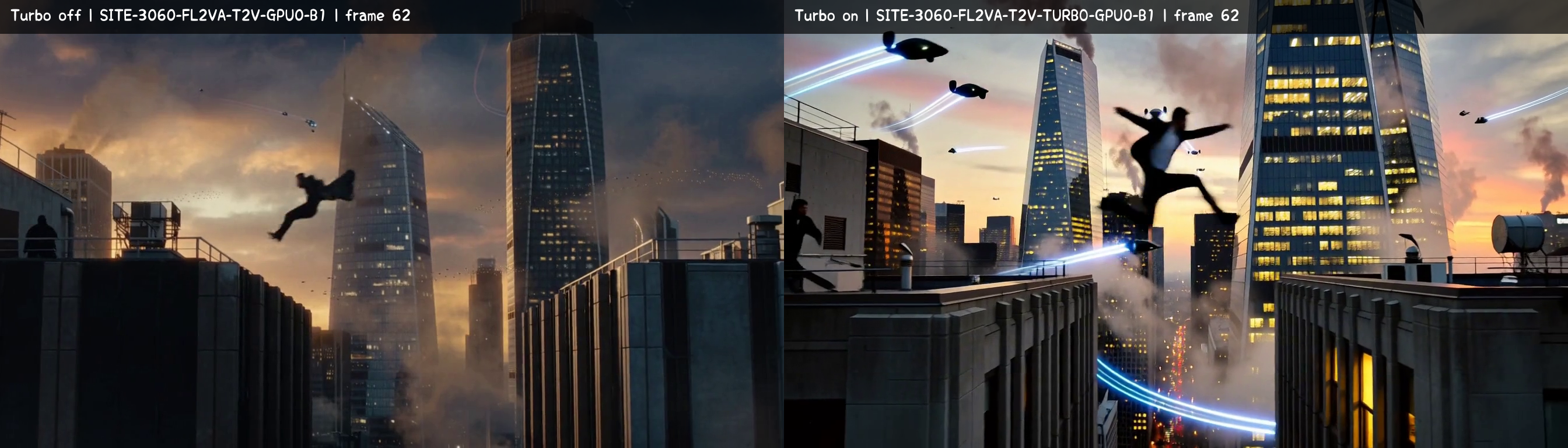
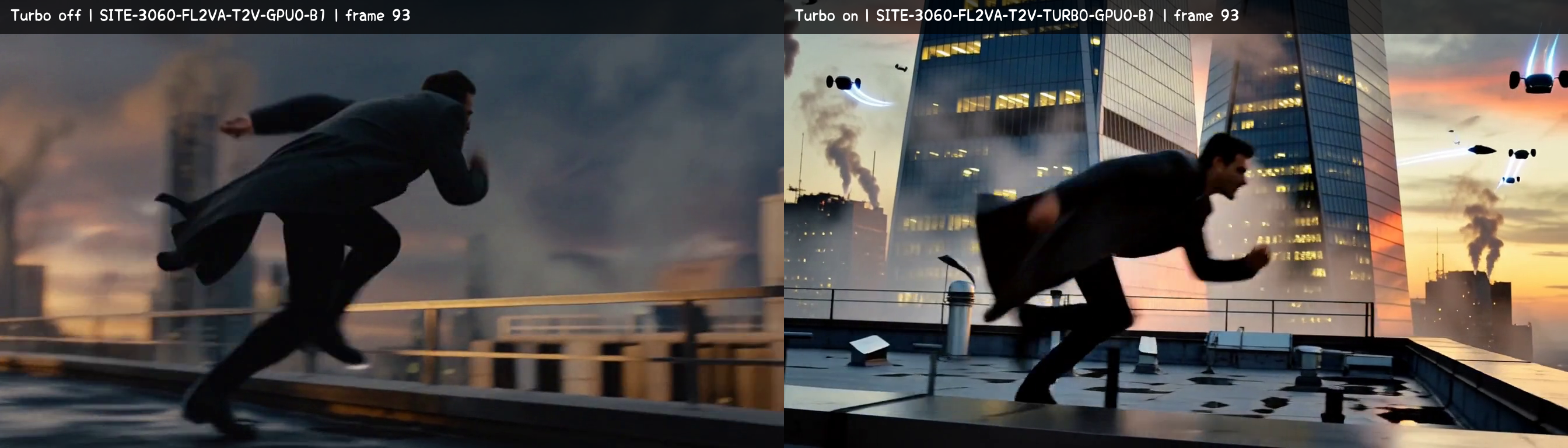
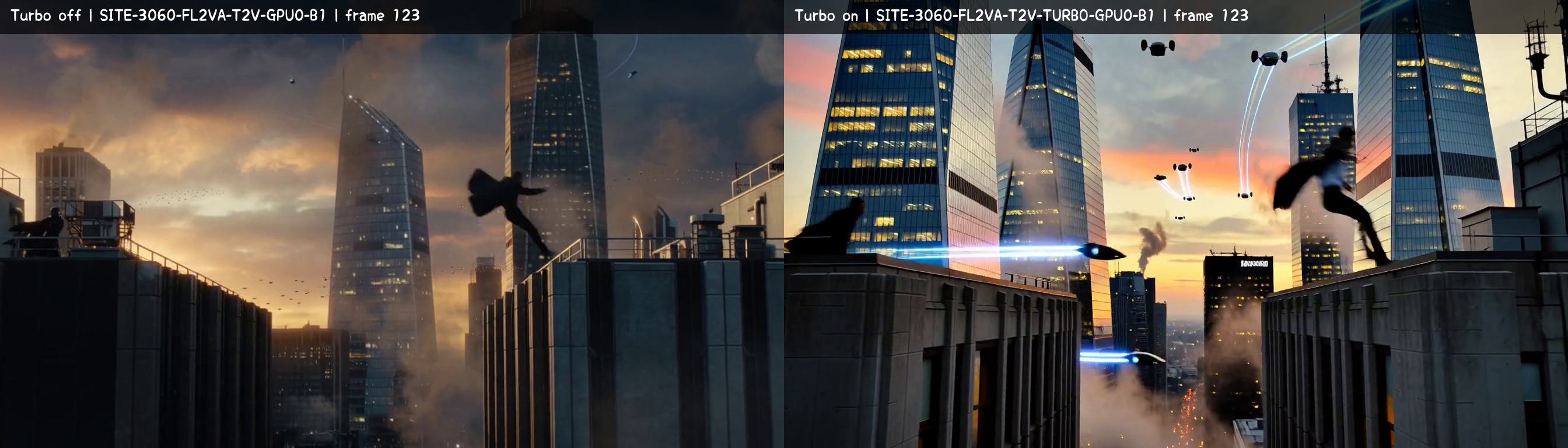
Each strip below places the Turbo-off frame on the left against the Turbo-on frame on the right at the same frame index, generated from the two runs above at the same seed. The strips are presented as they were produced; this page assigns no quality score, winner or preference to either side, and the labels you see are part of the source images.
Frame 0 of 124 · left: Turbo off · right: Turbo on · seed 20260820 · 1344×768Frame 31 of 124 · left: Turbo off · right: Turbo on · seed 20260820 · 1344×768Frame 62 of 124 · left: Turbo off · right: Turbo on · seed 20260820 · 1344×768Frame 93 of 124 · left: Turbo off · right: Turbo on · seed 20260820 · 1344×768Frame 123 of 124 · left: Turbo off · right: Turbo on · seed 20260820 · 1344×768
Three tracks, never merged
What you are allowed to do with these files
1 · The distilled LoRA itself
Apache-2.0 by lightx2v / ModelTC, the upstream authors of the LightX2V series. The Larryvrh series is separately Apache-2.0, verified through the Hugging Face API on 2026-08-19. Upstream terms were checked at revision ec01fa4c… on 2026-08-20.
2 · The download entrance and base model
The Comfy-Org repackage repository declares license: other / minimax-h3-community-license metadata at repository level, and the base model carries the MiniMax H3 Community License. Which terms you accept depends on which entrance you download from — the file-to-license map keeps them apart.
3 · The territory clause
The base license grants use, reproduction, modification, distribution and display only in the Applicable Territories — the world excluding the EU, the UK, the Republic of Korea and the United States. Read the source map for the clause text.
Separate · The text encoder
The Qwen3-VL-32B encoder is Apache 2.0 per the base license's Additional Note. That track is separate from the three above and is not merged into them.
This page deliberately avoids the phrases "official model license" and "MiniMax's official accelerator": provenance checks show the Turbo LoRAs are third-party distillations, and merging the license tracks would hide who actually grants what.
Before blaming your GPU
If it does not work
The workflow download 404s
If a template asks for minimax_h3_turbo_4step_pruned_comfyui.safetensors, RunComfy's Comfy-Org /H3/ link is dead — the template points at the wrong repository. Do not replace only the file name: either repair the template for the pruned-curve/Larryvrh path described above, or switch the workflow, base model, LoRA, steps and both shift schedules together to a matched official LightX2V set.
Steps do not match the file
Run the step count bound to the chosen file — the table above. Off-specification step counts such as a 6–8-step range are not variations this series supports.
Only video shift was set
Shift is two schedules. If the audio shift is left at its default while the video shift is changed, the configuration is incomplete — set both values from the same row.
The two series got mixed
Larryvrh's strength and shift values do not transfer to LightX2V files. Pick one series, take its whole parameter set, and do not combine — see the series table.
Ref2V Turbo at 768p
The only Ref2V Turbo file is a 544p-trained v0.1. Running it at 1344×768 is a training/inference mismatch, not a supported configuration — see why the A/B used FL2VA.
A different symptom
For loader errors, missing folders or stalls, start from the exact error in the symptom-led guide instead of changing several settings at once.
MiniMax H3 Community License Agreement (2026-08-02) authorises use, reproduction, modification, distribution and display of the weights and their Outputs only in the Applicable Territories — the world excluding the EU, the UK, the Republic of Korea and the United States. The distilled Turbo LoRAs are third-party Apache-2.0 works, but the base model weights they accelerate carry this territory clause, and §V.4 reaches Outputs as well as the weights themselves. This site quotes and links the license rather than advising on it — read the file-to-license map and the original agreement for your own situation.
FAQ
Frequently asked questions
Which Turbo LoRA file applies to a 1344×768 T2V or I2V run?
minimax_h3_fl2v_turbo_4step_v1.0_768p_comfyui_bf16.safetensors. Its bound specification at 1344×768 is 4 steps and a shift of 6 for video and 3 for audio, used as a set with the file name.
How much faster was the Turbo LoRA on your RTX 3060?
On the same machine and workload, the paired wall-time range was 4.113×–4.132×: Turbo off took 2,175.5 s and 2,176.2 s at 20 steps, Turbo on took 526.7 s, 528.9 s and 528.6 s at 4 steps. The range is published as a pairing, not an average.
Does the Turbo LoRA reduce VRAM or make an 8GB card work?
Our run did not establish a reliable peak-VRAM reduction: Turbo-off peaks were 11,023 and 10,863 MiB against Turbo-on peaks of 11,185, 10,479 and 10,895 MiB. All three Turbo peaks were above 8,192 MiB; this was not an 8GB-card test, so no 8GB claim is made in either direction.
Does minimax_h3_turbo_4step_pruned_comfyui.safetensors exist?
Not in the official Comfy-Org packaging. RunComfy's download anchor targets the exact /H3/minimax_h3_turbo_4step_pruned_comfyui.safetensors resolve URL, which returns 404; the separate official loras/ tree contains only the three _comfyui_bf16 files above. The same-named file does exist in the third-party drbaph conversion repository (620,285,648 bytes at the pinned revision, checked 2026-08-27), but it is a Larryvrh-derived pruned/curve-form conversion whose own metadata warns that four-step behaviour may be degraded or broken, so it is not an official equivalent.